
/** * Related Posts Loader for Astra theme. * * @package Astra * @author Brainstorm Force * @copyright Copyright (c) 2021, Brainstorm Force * @link https://www.brainstormforce.com * @since Astra 3.5.0 */ if ( ! defined( 'ABSPATH' ) ) { exit; // Exit if accessed directly. } /** * Customizer Initialization * * @since 3.5.0 */ class Astra_Related_Posts_Loader { /** * Constructor * * @since 3.5.0 */ public function __construct() { add_filter( 'astra_theme_defaults', array( $this, 'theme_defaults' ) ); add_action( 'customize_register', array( $this, 'related_posts_customize_register' ), 2 ); // Load Google fonts. add_action( 'astra_get_fonts', array( $this, 'add_fonts' ), 1 ); } /** * Enqueue google fonts. * * @return void */ public function add_fonts() { if ( astra_target_rules_for_related_posts() ) { // Related Posts Section title. $section_title_font_family = astra_get_option( 'related-posts-section-title-font-family' ); $section_title_font_weight = astra_get_option( 'related-posts-section-title-font-weight' ); Astra_Fonts::add_font( $section_title_font_family, $section_title_font_weight ); // Related Posts - Posts title. $post_title_font_family = astra_get_option( 'related-posts-title-font-family' ); $post_title_font_weight = astra_get_option( 'related-posts-title-font-weight' ); Astra_Fonts::add_font( $post_title_font_family, $post_title_font_weight ); // Related Posts - Meta Font. $meta_font_family = astra_get_option( 'related-posts-meta-font-family' ); $meta_font_weight = astra_get_option( 'related-posts-meta-font-weight' ); Astra_Fonts::add_font( $meta_font_family, $meta_font_weight ); // Related Posts - Content Font. $content_font_family = astra_get_option( 'related-posts-content-font-family' ); $content_font_weight = astra_get_option( 'related-posts-content-font-weight' ); Astra_Fonts::add_font( $content_font_family, $content_font_weight ); } } /** * Set Options Default Values * * @param array $defaults Astra options default value array. * @return array */ public function theme_defaults( $defaults ) { // Related Posts. $defaults['enable-related-posts'] = false; $defaults['related-posts-title'] = __( 'Related Posts', 'astra' ); $defaults['releted-posts-title-alignment'] = 'left'; $defaults['related-posts-total-count'] = 2; $defaults['enable-related-posts-excerpt'] = false; $defaults['related-posts-excerpt-count'] = 25; $defaults['related-posts-based-on'] = 'categories'; $defaults['related-posts-order-by'] = 'date'; $defaults['related-posts-order'] = 'asc'; $defaults['related-posts-grid-responsive'] = array( 'desktop' => '2-equal', 'tablet' => '2-equal', 'mobile' => 'full', ); $defaults['related-posts-structure'] = array( 'featured-image', 'title-meta', ); $defaults['related-posts-meta-structure'] = array( 'comments', 'category', 'author', ); // Related Posts - Color styles. $defaults['related-posts-text-color'] = ''; $defaults['related-posts-link-color'] = ''; $defaults['related-posts-title-color'] = ''; $defaults['related-posts-background-color'] = ''; $defaults['related-posts-meta-color'] = ''; $defaults['related-posts-link-hover-color'] = ''; $defaults['related-posts-meta-link-hover-color'] = ''; // Related Posts - Title typo. $defaults['related-posts-section-title-font-family'] = 'inherit'; $defaults['related-posts-section-title-font-weight'] = 'inherit'; $defaults['related-posts-section-title-text-transform'] = ''; $defaults['related-posts-section-title-line-height'] = ''; $defaults['related-posts-section-title-font-size'] = array( 'desktop' => '30', 'tablet' => '', 'mobile' => '', 'desktop-unit' => 'px', 'tablet-unit' => 'px', 'mobile-unit' => 'px', ); // Related Posts - Title typo. $defaults['related-posts-title-font-family'] = 'inherit'; $defaults['related-posts-title-font-weight'] = 'inherit'; $defaults['related-posts-title-text-transform'] = ''; $defaults['related-posts-title-line-height'] = '1'; $defaults['related-posts-title-font-size'] = array( 'desktop' => '20', 'tablet' => '', 'mobile' => '', 'desktop-unit' => 'px', 'tablet-unit' => 'px', 'mobile-unit' => 'px', ); // Related Posts - Meta typo. $defaults['related-posts-meta-font-family'] = 'inherit'; $defaults['related-posts-meta-font-weight'] = 'inherit'; $defaults['related-posts-meta-text-transform'] = ''; $defaults['related-posts-meta-line-height'] = ''; $defaults['related-posts-meta-font-size'] = array( 'desktop' => '14', 'tablet' => '', 'mobile' => '', 'desktop-unit' => 'px', 'tablet-unit' => 'px', 'mobile-unit' => 'px', ); // Related Posts - Content typo. $defaults['related-posts-content-font-family'] = 'inherit'; $defaults['related-posts-content-font-weight'] = 'inherit'; $defaults['related-posts-content-text-transform'] = ''; $defaults['related-posts-content-line-height'] = ''; $defaults['related-posts-content-font-size'] = array( 'desktop' => '', 'tablet' => '', 'mobile' => '', 'desktop-unit' => 'px', 'tablet-unit' => 'px', 'mobile-unit' => 'px', ); return $defaults; } /** * Add postMessage support for site title and description for the Theme Customizer. * * @param WP_Customize_Manager $wp_customize Theme Customizer object. * * @since 3.5.0 */ public function related_posts_customize_register( $wp_customize ) { /** * Register Config control in Related Posts. */ // @codingStandardsIgnoreStart WPThemeReview.CoreFunctionality.FileInclude.FileIncludeFound require_once ASTRA_RELATED_POSTS_DIR . 'customizer/class-astra-related-posts-configs.php'; // @codingStandardsIgnoreEnd WPThemeReview.CoreFunctionality.FileInclude.FileIncludeFound } /** * Render the Related Posts title for the selective refresh partial. * * @since 3.5.0 */ public function render_related_posts_title() { return astra_get_option( 'related-posts-title' ); } } /** * Kicking this off by creating NEW instace. */ new Astra_Related_Posts_Loader(); Understanding Global Sanctions Programs An In-Depth Overview – Quality Formación

Understanding Global Sanctions Programs An In-Depth Overview

Understanding Global Sanctions Programs: An In-Depth Overview

Sanctions programs are a crucial tool used by nations and international organizations to influence the behavior of countries, organizations, or individuals that pose a threat to peace and security. By imposing economic, diplomatic, or military restrictions, these programs aim to enforce international law and promote global stability. This article provides a detailed sanctions programs overview, examining their various forms, objectives, and the implications they have on global politics.

What are Sanctions?

Sanctions are measures taken by countries or international authorities to compel a particular behavior from another state or entity, often in response to violations of international norms, such as human rights abuses, aggression against another state, or support for terrorism. Sanctions can be either unilateral, imposed by one country, or multilateral, enacted by a coalition of countries or through international organizations like the United Nations (UN).

Types of Sanctions Programs

Sanctions programs can be classified into several categories based on their scope and purpose:
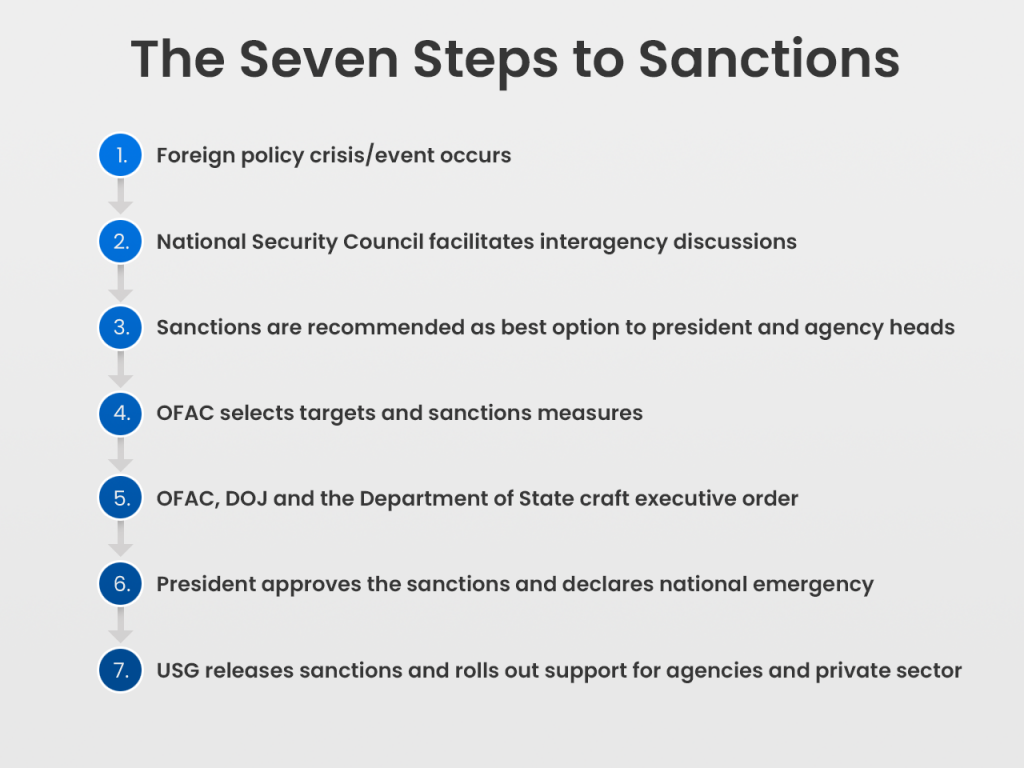
1. Economic Sanctions

Economic sanctions are perhaps the most common form, aimed at restricting trade and financial transactions. These can include:

  • Trade Embargoes: Prohibiting the import or export of specific goods.
  • Asset Freezes: Blocking access to assets held in foreign countries.
  • Financial Sanctions: Limiting access to financial markets and services.

2. Diplomatic Sanctions

These involve reducing or severing diplomatic relations. This might include recalling ambassadors, expelling diplomats, or limiting official communications.

3. Military Sanctions

Military sanctions often include arms embargoes or restrictions on military cooperation and assistance. These are usually imposed to mitigate the risk of conflict escalation.

4. Travel Bans

Travel bans restrict certain individuals from entering specific countries. This is of

ten directed at political leaders, military officials, or individuals accused of serious crimes.

Objectives of Sanctions Programs

Sanctions serve various purposes, including:

  • Compelling Compliance: Encouraging a target to comply with international law or cease objectionable behavior.
  • Punishment: Signaling disapproval of abhorrent actions, such as human rights violations.
  • Deterrence: Preventing future misconduct by the sanctioned state or entity by showcasing consequences.
  • Promoting Change: Supporting movements aimed at social, political, or economic reform.

The Impact of Sanctions

The effectiveness and consequences of sanctions can vary widely. In some cases, sanctions have successfully altered the behavior of the targeted entities, while in other instances, they have failed to yield significant change or have had unintended consequences.

Positive Impacts

When properly implemented and supported by strong international backing, sanctions can lead to:

  • Successful negotiation and peace agreements.
  • Pressure on governments to respect human rights.
  • Regime change in extreme cases.

Negative Consequences

Conversely, sanctions can also have adverse effects, including:

  • Harm to civilian populations, leading to humanitarian crises.
  • Economic downturns that may bolster authoritarian regimes.
  • Increased resentment against the sanctioning countries.

Challenges in Implementing Sanctions

Implementing and enforcing sanctions poses numerous challenges:

  • Compliance and Evasion: Targeted entities often seek ways to circumvent sanctions through illicit networks.
  • International Unity: A lack of consensus among international actors can dilute the effectiveness of sanctions.
  • Timing and Duration: The need for timely and appropriate sanctions, as well as their duration, can be contentious.

Recent Trends in Sanctions Programs

In recent years, there has been a noticeable shift in the use and targeting of sanctions:

  • Smart Sanctions: These are targeted measures aimed at individuals or specific entities rather than broad economic sanctions, minimizing harm to civilians.
  • Increased Use of Technology: Advances in global finance and communication have led to new challenges in enforcement and evasion.
  • Importance of Compliance Monitoring: Ensuring compliance has become a critical component, with greater attention to monitoring mechanisms.

Conclusion

Sanctions programs remain a vital component of international relations, employed to navigate complex geopolitical landscapes. While they can be effective in achieving their intended goals, the challenges inherent in their implementation and potential for unintended consequences underscore the need for careful consideration and international cooperation. Understanding the nuances of these programs is crucial for policymakers and global citizens alike in fostering a more peaceful and just world.

monopoly casino